
BOONE, N.C. — Appalachian State University's Department of Philosophy and Religion welcomed scholars and students from across the region to App State's Boone campus on Saturday, Oct. 31, as it hosted the 2026 annual meeting of the North Carolina Religious Studies Association (NCRSA) in Sanford Hall, the department's new home since August. The conference continued a tradition of more than 30 years of NCRSA meetings hosted by colleges and universities across North Carolina.
The annual gathering brought together faculty, students, and scholars to share research and engage in discussion on a wide range of topics in religious studies. Throughout the day, participants presented work on global religious traditions, philosophy, culture, ecology, technology, ethics, and history.
The conference also highlighted undergraduate scholarship through its annual student awards. Senior religious studies and philosophy double major Lucas White received the Undergraduate Presentation Award for his presentation, "Bodies in the Architecture: Human Sacrifice and Monumentality at Cahokia's Mound 72." The project originated in a course taught by Department of Philosophy and Religion professor Dr. Thomas Ellis. White credited Ellis with introducing him to many of the research skills and theoretical frameworks that informed the paper.
White's presentation — included in the conference's "Indigenous, Ancient, and African Religious Traditions" session — examined evidence of human sacrifice at Cahokia's Mound 72, part of the ancient Indigenous city of Cahokia near present-day St. Louis. His research explored how sacrifice may have been used to reinforce social order and political authority during periods of rapid growth and environmental uncertainty. The project focused on burial contexts associated with Mound 72 that shed light on daily life in one of North America's largest pre-Columbian urban centers and the role sacrifice may have played in maintaining social and political order.
The project grew out of White's broader interest in the relationships among violence, culture, and authority. Although his primary research focuses on the religions of South Asia, he was drawn to Cahokia because of its proximity and because it challenges long-standing assumptions about pre-Columbian North America.
His research suggests that Cahokia challenges common perceptions of Indigenous North American societies and complicates narratives that often associate large-scale ritual sacrifice primarily with Mesoamerican civilizations. Instead, the project argues that sacrificial practices played an important role in how Cahokians understood political power and organized community life.
"My goal, with 'Bodies in the Architecture' and beyond, is to understand violence and sacrifice not as random, destructive forces, but as phenomena that are constantly changing and constitutive of every society that has hitherto existed," White said.
The presentation sparked conversations with scholars working in a variety of religious traditions and historical periods, underscoring the broader significance of the topic.
"When I presented this paper at NCRSA, nearly every scholar I spoke with had at least one example of sacrifice in their own field that it brought to mind," shared White. "Sacrifice and religious violence are uniquely widespread phenomena."
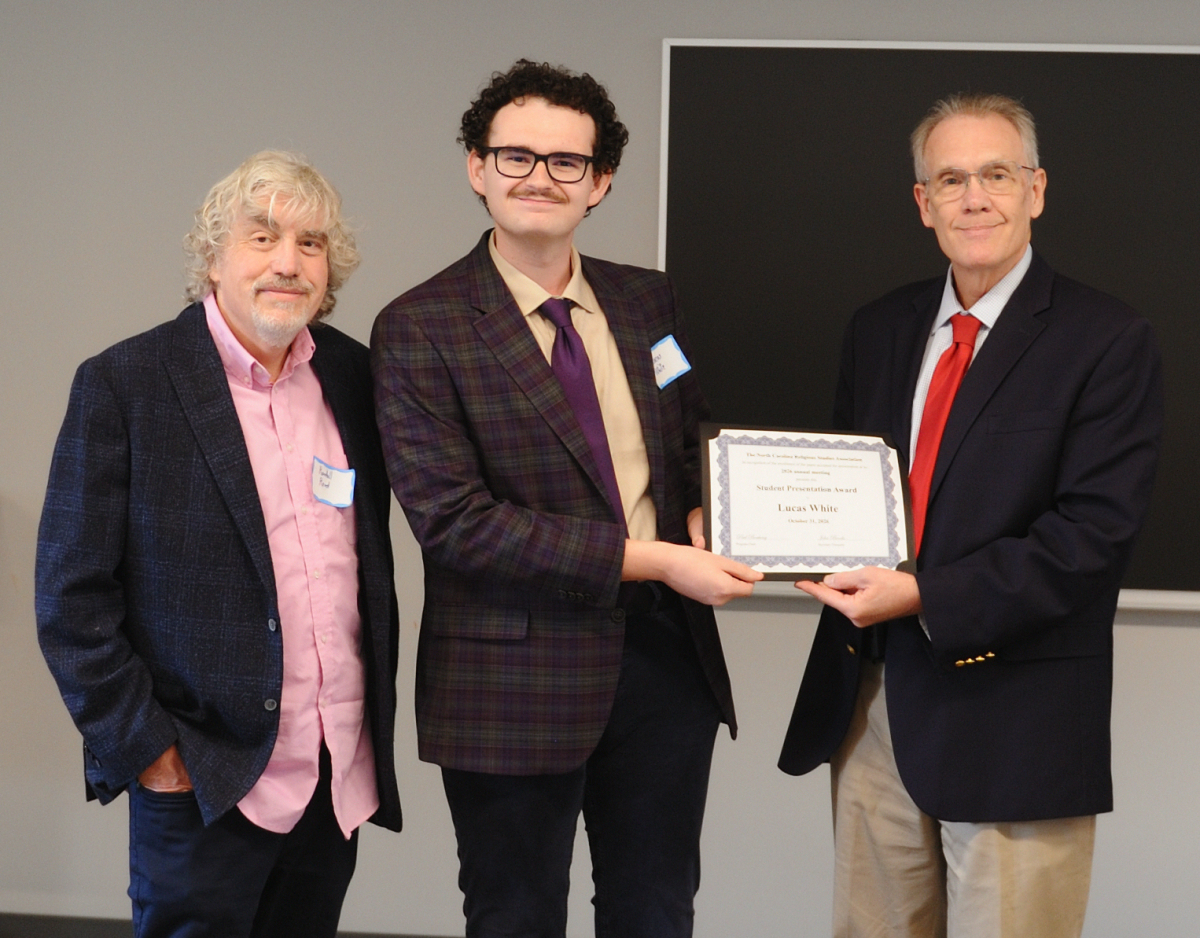
App State Department of Philosophy and Religion professor Dr. Randall Reed (left) and Fayetteville State University associate professor Dr. John Brooks (right) present senior religious studies and philosophy major Lucas White with the North Carolina Religious Studies Association's Undergraduate Presentation Award on Saturday, Oct. 31. Photo by Dr. Michael Eng
Hosted in Sanford Hall, this year's meeting provided an opportunity for App State students and faculty to share their work while welcoming scholars from across North Carolina to campus.
###
About the Department of Philosophy and Religion
The Department of Philosophy and Religion invites students to critically and creatively examine the beliefs, values, practices, and institutions that shape human lives. Through this work, students develop as reflective and resilient individuals who contribute to their communities in constructive and meaningful ways. The department offers a Bachelor of Arts in philosophy and a Bachelor of Arts in religious studies, as well as minors in philosophy; philosophy and religious studies; philosophy, politics, and economics; and religious studies. Learn more about App State's Department of Philosophy and Religion
By Lauren Gibbs
November 4, 2026
BOONE, N.C.
Appalachian State University Department of Philosophy and Religion logo featuring a block "A" Mountaineers mark above the department name on a black background.
The Appalachian State University Department of Philosophy and Religion, housed in the College of Arts and Sciences, invites students to critically and creatively examine the beliefs, values, practices, and institutions that shape human lives. Through this work, students develop as reflective and resilient individuals who contribute to their communities in constructive and meaningful ways.